This version tests that. We rebuilt the data at the level of each brand, for each question, in each assistant’s answer, added measures of how prominent each brand is and how widely independent sites cover it, and compared brands within the same question. The pattern version 1.0 described is real, but most of it goes away once prominence is accounted for.
The short version
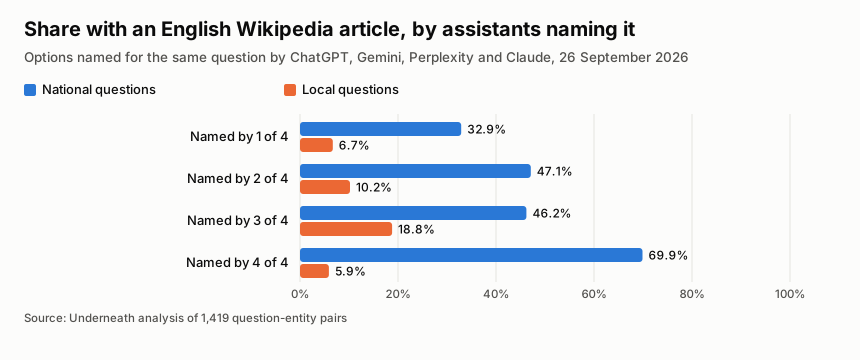
- The raw pattern holds: of the options all four assistants named for a question, 60.0% have an English Wikipedia article, against 20.6% of options only one assistant named.
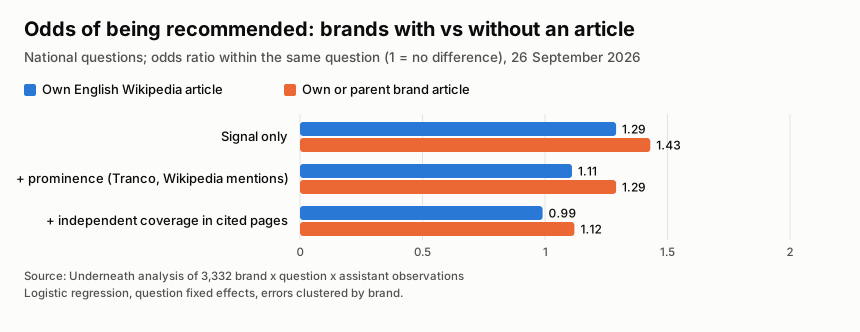
- Comparing options within the same national question, an article goes with modestly higher odds of being recommended by a given assistant (odds ratio 1.29, 95% interval 1.03 to 1.61).
- Most of that goes once prominence is accounted for: the odds ratio falls to 1.11 (0.81 to 1.51) after adding the brand website’s traffic rank and how often Wikipedia mentions the brand, and to 0.99 after adding independent coverage in the pages the assistants cited.
- Independent coverage was the strongest predictor we measured: each tenfold increase in the number of independent sites naming a brand in the cited pages went with 4.7 times the odds of being recommended.
- Where an article made any difference, it was in the evidence, not the choice: brands with an article were more often named in the pages an assistant cited (74.3% against 59.5%), and once named there, were recommended at the same rate (50.2% against 48.9%).
- On local questions (a business in a named place), no entity signal made a difference in any model.
- Of the 110 options all four assistants named for a question, 21 have no Wikipedia article for themselves or their parent brand; 11 of them are local businesses.
Where this study fits
Research on AI search has moved through three questions, and this study addresses the fourth.
- Can content change an answer once it is retrieved? The original generative engine optimization paper (Aggarwal et al., 2024 (opens in a new tab)) showed that rewriting a source that is already in an AI system’s context can raise its visibility in the answer by up to 40%.
- Which sources do AI systems use? Comparative work (Chen et al., 2025 (opens in a new tab)) found that AI search engines lean heavily on earned, third-party sources rather than brand-owned pages, differ from Google and from each other, and show a “big brand bias”.
- What remains unknown? A 2026 critical survey (Martinez, 2026 (opens in a new tab)) concludes that the evidence covers content already retrieved, not organic discoverability: what makes a brand enter the evidence in the first place is still open.
- This study looks at one layer of that question: whether the way a brand is represented as an entity on the public web (Wikipedia, Wikidata, homepage structured data) goes with being recommended by several assistants, and whether that holds once prominence is accounted for.
We use a working model of how a recommendation forms: the public web describes the brand; an assistant retrieves and cites some pages; it selects options from them; it recommends and ranks them; several assistants may or may not agree; and the result may or may not repeat on the next run. This model is proposed, not tested. We observe the entity signals, the cited pages, the recommendations, ranks and agreement, and stability on a subset; we do not observe crawling, indexing or what users do next.
Research questions
- How consistently do the four assistants recommend the same brands for the same buyer question?
- Are entity signals associated with being recommended, for each brand, question and assistant?
- Does the association remain after accounting for brand prominence and independent coverage?
- Does it differ by assistant, by question wording, and between national and local questions?
- Are brands with an article named more consistently across repeated runs?
- What do the exceptions look like: brands every assistant named without an article, and brands with an article only one assistant named?
What we analyzed
The answers come from our four-assistant study: ChatGPT, Gemini, Perplexity and Claude each answered the same 80 US buyer questions (ten in each of eight industries, 24 naming a place) on 26 September 2026, 320 answers in all. No new AI questions were asked for this version.
- Unit of analysis. Every option named in those answers was coded by a model (Claude Opus) as recommended or merely mentioned, with its rank. That gives 1,419 question-option pairs and, for each pair, one row per assistant: 5,676 observations. Version 1.0 reduced each brand to one number, the most assistants that named it for any question.
- Outcomes, from weakest to strongest. Mentioned; recommended; ranked in the top three; the number of assistants recommending it for the question; and, for 20 questions asked five times, the share of runs that named it.
- Entity signals. An English Wikipedia article; a Wikidata entry (and whether it lists social profiles); Organization structured data and sameAs links on the homepage. Version 2.0 finds articles two ways: through a Wikidata match, as in version 1.0, and by looking up the option’s own name as a Wikipedia title. A separate measure also counts an article for the parent brand (QuickBooks for QuickBooks Online).
- Prominence. The brand website’s rank in the Tranco list of the top million sites, and the number of English Wikipedia articles that mention the brand’s name. We also tried to count news coverage; the news database refused our requests, so news is not measured.
- Independent coverage. How many different websites, other than the brand’s own, name the brand among the readable pages cited anywhere in the study. This sits inside the assistants’ own evidence, so it is partly the same process as the outcome; we report it as a separate step.
- Comparisons. Each model compares options within the same question and assistant (question fixed effects), with uncertainty that allows for the same brand appearing several times. National and local questions are analyzed separately.
Version 1.0’s brand list came from an automatic extractor that missed 453 of the 1,419 options the model coder found (Vanguard and several law firms among them). This version gives those options the same signals with the same rules.
Finding 1: the pattern version 1.0 described is still there
Share with an English Wikipedia article, by how many assistants named the option
| Named by | National | Local | All |
|---|---|---|---|
| 1 of 4 | 32.9% | 6.7% | 20.6% |
| 2 of 4 | 47.1% | 10.2% | 32.7% |
| 3 of 4 | 46.2% | 18.8% | 39.0% |
| All 4 | 69.9% | 5.9% | 60.0% |
The national rows cover 511, 138, 91 and 93 options; the local rows 449, 88, 32 and 17.
Chart: share with an article, by assistants naming it
From mention to agreement, national questions
| Outcome | With article | Without |
|---|---|---|
| Mentioned by a given assistant | 50.3% | 37.9% |
| Recommended by a given assistant | 42.0% | 34.2% |
| Recommended, when mentioned | 83.5% | 90.1% |
| In the top 3, when recommended | 58.1% | 47.6% |
| Assistants recommending (mean of 4) | 1.68 | 1.37 |
| Recommended by 3 or 4 assistants | 29.4% | 15.4% |
Options with an article are mentioned more often but are slightly less often recommended once mentioned: large companies and platforms (Google Workspace, Microsoft Teams) are often named in passing rather than put forward as a pick.
Finding 2: most of the association is prominence
Brands with an article are, above all, better-known brands: the article measure correlates at 0.654 with the website’s Tranco score. So we added prominence to the comparison step by step.
Odds of being recommended, national questions (odds ratio, 95% interval)
| Signal | Signal only | + prominence | + independent coverage |
|---|---|---|---|
| Own English Wikipedia article | 1.29 (1.03 to 1.61) | 1.11 (0.81 to 1.51) | 0.99 (0.73 to 1.33) |
| Own or parent brand article | 1.43 (1.17 to 1.74) | 1.29 (1.04 to 1.60) | 1.12 (0.90 to 1.39) |
| Wikidata entry | 1.33 (1.09 to 1.63) | 1.00 (0.72 to 1.39) | 0.79 (0.57 to 1.10) |
| Article, version 1.0 method | 1.27 (1.02 to 1.59) | 1.01 (0.73 to 1.40) | 0.93 (0.68 to 1.26) |
An odds ratio of 1 means no difference. Each model compares options within the same question and includes the assistant.
In percentage points, an article went with a 5.6-point higher chance of being recommended by a given assistant before controls, 2.2 points after prominence, and −0.3 points after independent coverage. A mixed model that treats brands and questions as random rather than fixed gives a small positive association after prominence (1.18, 1.06 to 1.33); either way it is small.
The broadest measure, an article for the brand or its parent, holds up after prominence but not after independent coverage. One reading, which this data cannot prove: brands with an established record are more widely written about by independent sites, and it is that coverage the assistants draw on. Independent coverage itself went with 4.7 times the odds of being recommended per tenfold increase (3.4 to 6.5), the largest association in the study.
Finding 3: evidence, not selection
Using the pages each assistant cited (fetched two days after the answers), we split the recommendation into two stages: was the option named in the pages the assistant itself cited, and, if so, did the assistant recommend it?
| National questions | With article | Without |
|---|---|---|
| Named in the assistant’s cited pages | 74.3% | 59.5% |
| Recommended, if named there | 50.2% | 48.9% |
| Recommended, if not named there | 16.0% | 14.6% |
After prominence controls, an article went with somewhat higher odds of appearing in the cited pages (1.38, 0.94 to 2.04) and no difference in being selected from them (0.95, 0.63 to 1.44). If an article matters at all, it matters for whether a brand is in the evidence, not for how the assistant chooses from it. That fits the earned-media finding in the literature.
Finding 4: homepage schema, sameAs and entity tiers
For the national brands whose homepage we could fetch (215 brands), Organization schema kept a clearer association than Wikipedia did: 1.54 (1.07 to 2.22) after prominence and 1.39 (0.99 to 1.97) after independent coverage. sameAs links: 1.36 (0.94 to 1.95) after prominence. These rest on a smaller, selected group, and Ahrefs’ controlled test (opens in a new tab) found that adding schema did not raise AI citations, so we read this as a marker of organizational maturity rather than an effect of the markup.
We also grouped homepage-checked national brands into tiers of entity representation.
| Tier | Brands | Recommended by 3 or 4 | Assistants recommending |
|---|---|---|---|
| Weak: no Wikidata, no article, no schema | 5 | 14.3% | 1.43 |
| Partial | 122 | 24.7% | 1.58 |
| Strong: Wikidata, schema and sameAs | 46 | 20.0% | 1.64 |
| Strong and widely covered | 42 | 39.7% | 1.91 |
“Widely covered” means more independent domains in the cited pages than the median (9). Strong markup alone did no better than partial; the jump comes with independent coverage. The trend across tiers was not significant after prominence (1.22 per tier, 0.96 to 1.54), and the weak tier is only five brands.
Finding 5: no clear differences by assistant or wording, and none locally
- By assistant (national, after prominence): ChatGPT 1.37, Gemini 1.19, Claude 1.42, Perplexity 0.68; none is individually significant, and the four do not differ significantly from each other (p = 0.12).
- By question wording: plain “best X” questions 0.88, questions with a constraint (“for a small business”, “under $100,000”) 1.00, and questions about an attribute (“most reliable”, “cheapest”) 2.51 (1.24 to 5.10). The attribute group is only 8 national questions and the overall test for a difference is not significant (p = 0.28), so treat this as a lead to test, not a finding. Every question in the study asks for a recommendation; informational and transactional questions are not covered.
- Local questions: an article went with no difference before or after controls (1.07, 0.74 to 1.53; 1.02, 0.65 to 1.60), and the same held for Wikidata, schema and sameAs. Only 46 of the 586 local question-option pairs have an article, and the national and local associations do not differ significantly (p = 0.36), so the data cannot say whether entity signals work differently locally, only that no effect is visible there.
Finding 6: repeated runs
For 20 of the questions, ChatGPT, Gemini and Perplexity answered five times (from our consistency study). On national questions, brands with an article were named in four or five of the five runs 61.1% of the time, against 43.6% without. After prominence, the difference in the share of runs was 2.7 points (−7.8 to 13.1): brands with articles are more stable mainly because they are more prominent.
Finding 7: matched pairs
Within each national question, we paired every option that has an article with the most similar option that does not, on traffic rank, Wikipedia mentions and independent coverage. Only 42 of the 340 options with an article had a close enough partner: most brands with an article are simply far more prominent than any brand without one in the same answer. In those 42 pairs, the option with an article was recommended by 0.17 fewer assistants on average (−0.64 to 0.33); it was ahead in 26.2% of pairs, tied in 40.5% and behind in 33.3%. The pairs are few, but they give no sign that an article helps when prominence is equal.
The exceptions
Consensus without an article
110 options were named by all four assistants for a question. The automatic checks found no article for 44 of them. We looked each one up.
| On review | Options | Examples |
|---|---|---|
| Own article under another title | 8 | Wix (Wix.com), Jira, Betterment, Chubb |
| Product or program of a parent with an article | 15 | QuickBooks Online, Hilton Honors, Invisalign |
| No article found | 21 | OnPay, GlassesUSA, Navien, local firms |
Version 1.0 reported that 38 of the 96 brands named by all four assistants had no Wikipedia article; much of that was matching error and products of large parents. Real consensus without any encyclopedic record exists, but it is mostly local: 14 of the 21 come from local questions, where the assistants lean on directories, reviews and the business’s own site (the own site was cited for 38.1% of them).
An article, but only one assistant
198 options with an article were named by only one assistant. These are prominent (83.8% have a website in the Tranco top million; a median of 303 Wikipedia articles mention them), and the one assistant recommended them 63.1% of the time. ChatGPT (69) and Gemini (65) account for most, against Claude (38) and Perplexity (26). Many are adjacent or parent brands named alongside the real answer (Google Workspace, Slack or Zoom for a project management question), or large banks and chains one assistant added to a longer list. An article makes a brand available to be named; it does not make it the answer.
Identity errors along the way
- 145 options (10.2%) were named differently by different assistants, and 447 were recorded with a parent brand, so a brand’s identity is often split across names.
- Where Wikidata and the AI answers both give a website (51 brands), they agree 84.3% of the time; the rest include a Turkish American Express domain on Wikidata and Fidelity’s UK site for the US company.
- Wikidata search matched the wrong entity in 13 of 119 new matches (a product model, a same-name hotel elsewhere, a drink), and we rejected them on review.
What this means
This is interpretation. The data shows associations, not causes.
- A Wikipedia article is mostly a sign of a brand the web already knows well. Within the same question, once website traffic rank and encyclopedic mentions are accounted for, an article adds little or nothing to the chance of being recommended.
- Independent coverage is where the difference is. The brands the assistants agree on are the ones many independent sites write about, and the difference sits in whether a brand appears in the pages an assistant cites. That matches the earned-media bias other researchers found.
- Keep the entity record accurate anyway. A correct Wikidata entry, Organization schema with sameAs links to real profiles, and consistent names and websites cost little and prevent the identity errors above. Wikipedia has strict notability and conflict-of-interest rules, so an article is not something a company can simply write for itself.
- For local businesses, look elsewhere. No entity signal made a difference locally. Our ChatGPT local study points to Google Business Profile data and local review sites instead.
What comes next
- Repeated runs for all four assistants over several weeks, so that agreement and stability can be separated properly.
- News coverage and search demand as prominence measures, and coverage measured outside the assistants’ own citations.
- Controlled tests that change a brand’s entity record (for example, a corrected Wikidata entry) and track recommendations before and after.
How this compares with other studies
A claim that “entities with Wikipedia pages are 50% more likely to appear in AI-generated top-ten lists” is widely repeated. The source we could trace, an ALLMO article (opens in a new tab) citing Semrush research from 2025, says something narrower: that half of the marketing agencies most often cited in AI answers had Wikipedia pages, from 58 questions to four assistants. Neither version accounts for prominence; ours suggests that once it is, most of the Wikipedia association goes. On structured data, Ahrefs’ controlled test of 1,885 pages found adding schema “produced no major uplift in citations on any platform”. Chen et al. (opens in a new tab) found AI search leans on earned media and favors big brands, which fits our finding that independent coverage, not the entity record, carries the association. The critical survey by Martinez (opens in a new tab) calls for repeated observations, several engines and hierarchical models; this version moves toward that, with the gaps listed below.
Methodology
- Answers: 320 answers (ChatGPT and Gemini consumer apps via DataForSEO, Perplexity sonar and Claude Haiku 4.5 through their APIs with web search; 80 US buyer questions; 26 September 2026) from our four-assistant study. Options coded by Claude Opus, all four answers to a question at once with the assistants hidden: recommended or mentioned, rank, type, parent brand.
- Panel: 1,419 question-option pairs × 4 assistants = 5,676 rows; 1,282 distinct brands. 453 pairs added in version 2.0 with the version 1.0 rules.
- Wikipedia article (primary): Wikidata match with an English sitelink, or the option’s own name resolves to a Wikipedia page (redirects followed) whose short description fits the industry; a redirect to a different title counts only as a parent article. All 40 title additions and all 119 new Wikidata matches were reviewed by Claude, not by a person; 13 matches and 6 titles were rejected.
- Homepage signals: Organization-type JSON-LD and sameAs, fetched 26 to 28 September 2026 with the version 1.0 fetcher.
- Prominence: Tranco list 64X3X (downloaded 28 September 2026), scored as 6 minus log10 of the rank, with a flag for sites outside the top million; English Wikipedia full-text mentions of the brand name.
- Independent coverage: distinct domains, excluding the brand’s own, among the 1,419 readable pages (of 2,209 cited) that name the brand.
- Models: logistic regression with question fixed effects and assistant, standard errors clustered by brand; added in steps (signal only, plus prominence, plus independent coverage); Bayesian mixed model with random intercepts for brand and question as a check; likelihood-ratio tests for interactions. Matched pairs: standardized distance of 0.5 or less, without replacement; intervals from 2,000 bootstrap resamples (seed 20260928).
- Question wording: a rule on the wording: attribute (“most reliable”, “cheapest”, “best value”), constrained (“for a small business”, “under $100,000”) or plain.
- Update schedule: quarterly, with the next four-assistant run.
Limitations
- Observational. Prominence, independent coverage and entity signals move together, so their separate contributions come with wide intervals, and few brands with an article have a comparable brand without one.
- Only options at least one assistant named are in the data, so the study compares named brands with each other; brands no assistant named are not observed.
- The prominence measures are partial: website traffic rank and Wikipedia mentions, without news, search demand or revenue.
- Independent coverage is counted in the pages the assistants cited, two days later, so it is partly the same process as the outcome.
- One run per assistant on one date (five runs for 20 questions and three assistants), US English, and recommendation questions only.
- Entity matching still misses some articles under ambiguous names; all reviews were done by a model, not a person.
What changed in version 2.0
- Unit of analysis: from each brand’s maximum number of assistants to every option, question and assistant (5,676 rows), with mention, recommendation, rank, agreement and stability as separate outcomes.
- Coverage: 453 options version 1.0’s extractor missed were added, and a second article check by Wikipedia title found articles the Wikidata search missed.
- Controls: prominence and independent coverage added; comparisons made within the same question.
- Headline: version 1.0 reported that brands with an article were named by three or four assistants 47.5% of the time, against 24.5% without, on national questions. That descriptive gap is real, but most of it reflects prominence. “38 of 96 brands named by all four have no article” is replaced by 21 of 110 after review. Version 1.0 figures are kept in stats.json.
Data and downloads
- Every option, question and assistant with outcomes and signals: s12_panel_v2.csv and JSON
- Every brand with its signals, prominence and coverage: s12_brands_v2.csv
- Matched pairs: s12_matched_pairs.csv
- Version 1.0 brand table: s12_brand_entities.csv
- Every statistic on this page, and the version 1.0 statistics: stats.json
- Machine-readable methodology: methodology.json
The data is free to reuse with attribution (CC BY 4.0).
To cite: Underneath. (2026). Do Wikipedia and schema make AI assistants recommend a brand? (Version 2.0). Underneath Research. https://underneath.agency/research/brand-entity-ai-recommendations-study
Frequently asked questions
Does having a Wikipedia page help a brand get recommended by ChatGPT?
Brands with a Wikipedia article are named by more AI assistants, but in our data that is mostly because they are better-known brands. Comparing brands within the same question, the association fell from an odds ratio of 1.29 to 1.11, with an interval that includes no effect, once website traffic rank and Wikipedia mentions were accounted for.
What predicts whether several AI assistants recommend the same brand?
In our data, the strongest predictor was independent coverage: how many different websites name the brand in the pages the assistants cite. Brands with an article were more often in those pages, but once there, they were recommended at the same rate as brands without one.
Do local businesses need a Wikipedia page for AI recommendations?
Our data suggests not. Only 46 of the 586 local options have an article, and no entity signal made a difference to how often the assistants recommended local businesses.
Does Organization schema help AI assistants recommend a brand?
Among national brands whose homepage we could check, Organization schema went with higher odds of being recommended even after prominence (1.54). A controlled test by Ahrefs found adding schema did not raise AI citations, so the difference probably reflects the kind of company that publishes schema.
Can a brand be recommended by every AI assistant without a Wikipedia page?
Yes. Of the 110 options all four assistants named for a question, 21 had no article for themselves or a parent brand, and most of those were local businesses.