The short version
- The AI Overview mostly cites videos that are not on the results page. Of 629 YouTube citations in AI Overviews, only 15.1% (95% interval 10.1% to 19.2%) were videos Google also showed on page one of the same search. Those that were not on the page were much smaller: a median of 2,776 views and 21,400 subscribers, against 34,100 views and 77,000 subscribers for the ones that were.
- Within the same search, being popular did not help. Where the AI Overview cited one video Google showed and skipped another, the cited video had more views in 39.7% of pairs and a bigger channel in 37.0% (50% would mean no difference). Holding the other measures fixed, a bigger channel lowered the odds of citation (odds ratio 0.72 per standard deviation, 95% interval 0.54 to 0.97) and views made no difference (1.05, 0.78 to 1.42).
- Shorter and older videos were favored. Holding the other measures fixed, longer videos were less likely to be cited (odds ratio 0.7 per standard deviation) and older ones more likely (1.29). Cited videos had a median length of 266 seconds, against 398 for the shown videos that were not cited.
- The text Google shows for a cited video comes from what is said in it. For 97.9% of 616 cited videos with a text excerpt, the excerpt was not in the video’s description. 97.3% of those excerpts began in lowercase, like YouTube’s automatic captions, and 99.4% of the videos we could check had captions.
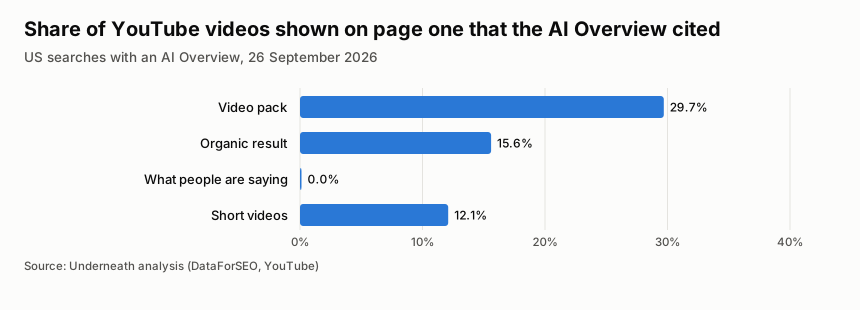
- The results-page feature matters, the slot does not. The AI Overview cited 29.7% of videos in Google’s video pack, 15.6% of YouTube organic results, 12.1% of short videos and none of the 111 videos in the “What people are saying” row. Within the video pack, the first, second and third slots were cited at similar rates (30.9%, 29.3%, 31.6%).
- The version 1.0 description still holds: the median cited video had 4,283 views and the median channel 34,900 subscribers.
Research questions
| Question | Answered here? |
|---|---|
| RQ1. Across all 800 searches, how often is there an AI Overview, a YouTube video on page one, and a cited YouTube video? | Yes |
| RQ2. Given that Google shows a video on page one, how likely is the AI Overview to cite it? | Yes, by results-page feature and slot |
| RQ3. Within the same search, how do cited videos differ from shown videos that were not cited? | Yes, for views, channel size, age, length, word match, description and captions |
| RQ4. Does the pattern hold in AI Mode and across industries? | Partly: AI Mode cites fewer videos, and industries differ |
| RQ5. Does the answer use what the video says, and represent it correctly? | No: not measured |
Visibility in stages
Being “cited by Google’s AI” is one stage of several. We measure four; three more are named because they matter, but this study does not measure them.
| Stage | Question | Measured? |
|---|---|---|
| AI Overview shown | Does the search show an AI Overview? | Yes |
| Shown on the results page | Does Google show the video on page one? | Yes, the only retrieval step we can see |
| Cited | Does the AI Overview cite the video? | Yes |
| Prominence | Where in the AI Overview’s sources does it sit? | Yes |
| Use | Did the answer take anything from the video? | No |
| Fidelity | Did the answer represent the video correctly? | No |
| User outcome | Did anyone watch or act on it? | No |
What we measured
We used the 800 US keywords of our AI Overview frequency study, 100 per industry across eight industries and 32 seed topics, and the Google results pages collected for them on 26 September 2026 (Google.com, United States, English, desktop), plus AI Mode answers for 400 of the same keywords. On each results page we recorded every YouTube video Google showed on page one (organic results, the video pack, the short-videos row and the “What people are saying” row) and every YouTube video the AI Overview cited. Version 1.1 made no new searches.
Because views and subscriber counts change daily, we re-read both the cited and the shown videos from YouTube on the same day, 28 September 2026, so the two groups are measured alike: 914 videos in all. The version 1.0 figures further down use the counts read on 26 September.
Every search stays in the results, including those with no AI Overview. Keywords that share a seed topic are not independent, so every 95% interval comes from resampling the 32 seed topics (2,000 resamples).
Findings
Every search, by outcome
| Outcome (800 searches) | Searches | Share |
|---|---|---|
| No AI Overview, no YouTube on page one | 233 | 29.1% |
| AI Overview cites a YouTube video, no YouTube on page one | 187 | 23.4% |
| AI Overview cites no YouTube video, no YouTube on page one | 135 | 16.9% |
| AI Overview cites a YouTube video, YouTube shown on page one | 122 | 15.2% |
| No AI Overview, YouTube shown on page one | 81 | 10.1% |
| AI Overview cites no YouTube video, YouTube shown on page one | 42 | 5.2% |
An AI Overview appeared on 60.8% of searches (95% interval 50.1% to 71.5%) and Google showed a YouTube video on page one of 30.6% (21.0% to 40.4%). The AI Overview cited a YouTube video on 38.6% of all searches. When YouTube was on page one, 74.4% of the AI Overviews cited a YouTube video (61.8% to 83.6%). When it was not, 58.1% still did (46.4% to 68.1%).
Most cited videos are not on the results page
| Where the cited video was on the page | Share of 629 |
|---|---|
| In the video pack | 12.6% |
| As an organic result | 1.9% |
| In the short-videos row | 0.6% |
| In “What people are saying” | 0.0% |
| Not on page one | 84.9% |
The videos the AI Overview found beyond the results page were far smaller than the ones it took from the page (medians):
| Cited videos | Videos | Views | Subscribers | Age (days) |
|---|---|---|---|---|
| Shown on page one | 95 | 34,100 | 77,000 | 352 |
| Not on page one | 534 | 2,776 | 21,400 | 329 |
For the most part, the AI Overview does not choose from the videos Google ranks for the search. It reaches much deeper into YouTube, which is why most cited videos are small.
Shown on page one, then cited
On searches with an AI Overview, Google showed 487 YouTube videos on page one, and the AI Overview cited 19.5% of them (95% interval 14.7% to 26.4%).
| Page feature | Shown | Cited | 95% interval |
|---|---|---|---|
| Video pack | 266 | 29.7% | 22.5% to 37.3% |
| Organic result | 77 | 15.6% | 5.3% to 31.1% |
| Short videos | 33 | 12.1% | 0.0% to 25.0% |
| What people are saying | 111 | 0.0% | 0.0% to 0.0% |
Within the video pack, slot made no clear difference: 30.9% of first-slot videos were cited, 29.3% of second and 31.6% of third.
Cited videos rarely lead the list. Of the 629 citations, 3.2% were the AI Overview’s first source and 18.9% among its first three; the median cited video was sixth of a median nine sources.
Cited against not cited, within the same search
This is the comparison version 1.0 could not make. We took the 111 searches where the AI Overview cited at least one video Google showed on page one and skipped at least one other (23 seed topics, 261 cited and 283 skipped videos). For each search we compared every cited video with every skipped one.
| Measure | Cited higher | 95% interval |
|---|---|---|
| Views | 39.7% | 33.3% to 45.9% |
| Channel subscribers | 37.0% | 30.9% to 44.2% |
| Age | 56.2% | 46.4% to 63.3% |
| Length | 41.6% | 29.7% to 53.7% |
| Title matches the search words | 48.5% | 44.4% to 51.6% |
| Description matches the search words | 49.6% | 42.4% to 55.9% |
| Description length | 42.9% | 33.8% to 53.3% |
| Has chapters | 47.3% | 39.7% to 56.7% |
| Has uploaded (not automatic) English captions | 54.7% | 50.4% to 58.6% |
“Cited higher” is the share of cited-against-skipped pairs in which the cited video had the higher value; 50% means no difference, and ties count as half.
| Same 111 searches | Cited | Skipped |
|---|---|---|
| Views | 12,066 | 15,301 |
| Channel subscribers | 50,050 | 84,500 |
| Age (days) | 399 | 256 |
| Length (seconds) | 266 | 398 |
| Mean share of search words in the title | 72.1% | 74.6% |
| Uploaded English captions | 21.0% | 12.1% |
Views and channel size move together, so we also fitted a model that compares cited with skipped videos search by search (a conditional logit, 535 videos) with all the measures at once. Odds ratios are per standard deviation.
| Measure | Odds ratio | 95% interval | p |
|---|---|---|---|
| Views | 1.05 | 0.78 to 1.42 | 0.736 |
| Channel subscribers | 0.72 | 0.54 to 0.97 | 0.028 |
| Age | 1.29 | 1.04 to 1.61 | 0.021 |
| Length | 0.7 | 0.54 to 0.91 | 0.007 |
| Title matches the search words | 0.77 | 0.59 to 1.01 | 0.063 |
| Description matches the search words | 1.09 | 0.83 to 1.42 | 0.552 |
| Description length | 1.14 | 0.87 to 1.51 | 0.337 |
Once channel size is held fixed, views no longer matter. A bigger channel, a longer video and a newer video each made citation less likely. Matching the search words in the title or description made no difference, perhaps because almost every video Google shows already matches them. Nearly every video had captions of some kind (100.0% of cited and 97.1% of skipped videos we could check), so captions cannot separate them.
What Google quotes from a cited video
Google shows a short text excerpt under most cited videos. We checked whether the first 40 characters of that excerpt, after the title, appear in the video’s description.
| Excerpt | Share of 616 |
|---|---|
| Found in the description | 2.1% |
| Not in the description | 97.9% |
| Not in the description and starting in lowercase | 97.3% of those |
| Not in the description, video has captions | 99.4% of those we could check |
The excerpts read like spoken words (“so you’re thinking about a tankless water heater…”). They look like YouTube’s automatic captions: what Google’s AI quotes is what is said in the video, not what is written under it. We did not download transcripts, so this is an inference from the excerpts.
AI Mode
AI Mode cited a YouTube video in 21.8% of its 400 searches (95% interval 12.8% to 32.2%), 173 citations in all. Only 8.1% of those were videos Google showed on page one, and AI Mode cited 4.6% of the videos shown there. 22.5% of AI Mode’s YouTube citations were also cited by the AI Overview for the same search. AI Mode relies even less on the results page than the AI Overview does.
By industry
| Industry | Cites YouTube | YouTube on page one | Shown videos cited |
|---|---|---|---|
| B2B software and technology | 91.0% | 37.0% | 41.7% |
| Financial services and insurance | 49.0% | 8.0% | 21.4% |
| Retail and ecommerce | 45.0% | 67.0% | 15.0% |
| Hospitality and travel | 42.0% | 24.0% | 9.4% |
| Home and local services | 36.0% | 58.0% | 16.5% |
| Healthcare and dental | 21.0% | 20.0% | 17.9% |
| Legal and professional services | 14.0% | 9.0% | 0.0% |
| Franchises and multi-location brands | 11.0% | 22.0% | 13.0% |
The first two columns are shares of the industry’s 100 searches; the last is the share of page-one videos the AI Overview cited. In B2B software, the AI Overview cited a YouTube video on 91.0% of searches, far more often than Google showed one on page one. In retail and home services, Google showed videos often but the AI Overview cited few of them.
The cited videos (version 1.0)
These figures describe every distinct video cited in AI Overviews and AI Mode, 469 in all, with counts read on 26 September.
Views
| Views | Share of cited videos |
|---|---|
| Under 1,000 | 26.1% |
| Under 10,000 | 60.9% |
| 1 million or more | 4.1% |
A quarter of cited videos had 856 views or fewer; three quarters had 35,450 or fewer.
Channel size
| Channel subscribers | Share of cited videos |
|---|---|
| Under 10,000 | 32.0% |
| Under 100,000 | 68.5% |
| 1 million or more | 6.5% |
The channels cited most often were specialists: OneHourProfessor, Gauging Gadgets and Brennan Valeski had five cited videos each; HR Toolbox, CRM Central, TechnologyAdvice, Eating on a Dime and a dental implant clinic’s channel had four.
Age and length
| Measure | Result |
|---|---|
| Median age | 377 days |
| Published within the last year | 48.9% |
| Older than 3 years | 15.6% |
| Older than 5 years | 6.8% |
| Median length | 6 minutes 6 seconds |
| One minute or shorter | 11.1% |
| Longer than 20 minutes | 9.0% |
Category and industry
YouTube classed the cited videos mainly as Education (129), People and Blogs (99), Howto and Style (96) and Science and Technology (60). Median views varied by industry: 21,066 for retail and 16,487 for franchise brands, but 1,403 for healthcare and 921 for legal services.
| Industry | Median views of cited videos |
|---|---|
| Retail and ecommerce | 21,066 |
| Franchises and multi-location brands | 16,487 |
| Home and local services | 7,829 |
| B2B software and technology | 3,794 |
| Hospitality and travel | 2,932 |
| Financial services and insurance | 1,532 |
| Healthcare and dental | 1,403 |
| Legal and professional services | 921 |
Observed, inferred and unknown
What we observe. Google’s AI Overviews cite YouTube on most searches where they appear, but mostly videos that Google does not show on the results page. Where they choose among the videos Google does show, they pick the smaller channel, the shorter video and the older video more often, and views make no difference once channel size is held fixed. The text Google shows for a cited video almost always comes from what is said in it.
What we infer. Popularity is not what gets a video cited. The AI appears to search YouTube for the spoken answer to the question and cite the video that gives it, which favors short, focused videos from specialist channels.
What remains unknown. Why a given video is picked: we see the results page but not the AI’s own search, so 84.9% of cited videos came from a step we cannot observe. Whether the answer actually uses what the video says, and uses it correctly. Whether the pattern holds from one run to the next. Transcript content was not analyzed.
What this means
The points below are our interpretation. They follow from the findings but were not tested.
- You do not need an audience to be cited. Within the same search, bigger channels were less likely to be cited, and views made no difference.
- Say the answer out loud, early. Google’s AI quotes what is spoken in the video. A video that states the answer to a common question plainly gives it something to quote.
- Keep it short and on one question. Cited videos were shorter than the videos Google showed and skipped for the same search.
- Ranking in the video pack is not the route in. Most cited videos were nowhere on the results page, and the slot in the video pack made no difference.
- Check your captions. Automatic captions are what the AI seems to read. Correcting them costs little; uploaded captions were slightly more common among cited videos, though the difference is small.
Where this sits in GEO research
Research on generative engine optimization began by asking whether changing a page changes how often an AI answer uses it. Later work compared the sources different AI search systems draw on, and argued that visibility should be measured in stages (retrieval, citation, prominence, use, fidelity) rather than as one score. Most of that work studies web pages. This study applies the stage view to video. It is observational: it compares cited videos with videos Google showed for the same search, not with every video the AI could have found, and it does not test whether changing a video changes its chances. Measuring whether cited videos shape the answer, and how accurately, is the next step.
Methodology
- Searches: the 800 US keywords of our AI Overview frequency study, 100 per industry, 32 seed topics; Google results pages with AI Overviews and, for 400 of the keywords, AI Mode answers (DataForSEO SERP API, Google.com, United States, English, desktop, 26 September 2026, one request each).
- Shown on page one: YouTube videos in organic results, the video pack, the short-videos row and the “What people are saying” row, each counted once per search at its first appearance.
- Cited: YouTube videos among the AI Overview’s sources and in-text links, in reading order, each counted once per search.
- Video data: version 1.1 re-read all 914 cited and shown videos on 28 September 2026, from the watch page or, when YouTube limited our requests, from YouTube’s public player data (views, date, length, description, channel size; caption data only from watch pages). Version 1.0 read the 469 cited videos on 26 September.
- Word match: the share of the search’s words (lowercased, common words removed) that appear in the title or description.
- Within-search comparison: for each search, the share of cited-against-skipped pairs in which the cited video has the higher value, averaged over searches; and a conditional logit with one group per search and standardized measures.
- Uncertainty: 95% bootstrap intervals resampling the 32 seed topics (2,000 resamples, seed 20260926); model intervals are the model’s own.
- Update schedule: quarterly.
Limitations
- The comparison group is the videos Google showed on page one, not every video the AI could have found. 84.9% of cited videos were not on the page, so the within-search comparison covers only the step from shown to cited.
- Observational, one run per search on one date. The study shows which videos were cited, not why, and run-to-run variation is not measured.
- Citation is not use. Whether the answer took anything from the video, and represented it correctly, is not measured; nor are views or clicks that came from the citation.
- View and subscriber counts are lifetime figures read two days after the searches; YouTube rounds subscriber counts.
- Word match is a rough measure of relevance, and transcripts were not analyzed. The within-search comparison covers 111 searches in 23 seed topics, so its intervals are wide.
What changed in version 1.1
Version 1.0 (26 September 2026) described the 469 cited videos. It said plainly that it could not compare them with videos that were not cited. Following an external review, version 1.1 (28 September 2026) adds that comparison using the same searches, with no new search queries: every YouTube video Google showed on page one serves as the comparison group. It also splits visibility into stages, counts every search as an outcome, adds prominence, AI Mode and industry breakdowns, and adds intervals clustered by seed topic. No version 1.0 figure changed; they appear above as the description of the cited videos. The new comparisons use counts re-read on 28 September for both groups.
Data and downloads
- Every cited or shown video for every search, version 1.1 (results-page feature, slot, cited or not, views, channel size, age, length, captions, word match): s20_videos_v11.csv and JSON
- Every cited video, version 1.0: s20_youtube_videos.csv and JSON
- Every statistic on this page: stats.json; version 1.0: stats_v1.0.json
- Machine-readable methodology: methodology.json
- Chart: shown videos cited, by results-page feature
The data is free to reuse with attribution (CC BY 4.0).
To cite: Underneath. (2026). The YouTube videos Google’s AI cites are small (Version 1.1). Underneath Research. https://underneath.agency/research/ai-overview-youtube-videos-study
Frequently asked questions
Do you need a big YouTube channel to be cited in Google AI Overviews?
No. Among videos Google showed for the same search, the ones from bigger channels were less likely to be cited, and views made no difference once channel size was held fixed. The median cited video came from a channel with 34,900 subscribers.
Does ranking in Google’s video pack get a video cited in AI Overviews?
Sometimes: the AI Overview cited 29.7% of video-pack videos, whichever slot they were in. But 84.9% of the YouTube videos AI Overviews cited were not on the results page at all.
What does Google’s AI read from a YouTube video?
Apparently what is said in it. For 97.9% of cited videos, the text Google showed was not in the description, and it read like YouTube’s automatic captions.
How long are the YouTube videos AI Overviews cite?
Short to mid-length: a median of 266 seconds on the searches where we could compare, against 398 seconds for the videos Google showed but did not cite.